When RV owners talk about off-grid power issues, the conversation usually starts in the wrong place. Most people immediately blame battery capacity:
“I need more amp-hours.”
“My battery doesn’t last long enough.”
“I should upgrade to a bigger system.”
But in real-world RV setups, the issue is rarely the battery's size—it’s how the entire energy ecosystem is designed and operated. Even with a massive, high-capacity solution like a 12V 460Ah lithium battery, users can still experience frustrating performance drops if the surrounding system isn't optimized.
Let’s dismantle the two biggest misconceptions about RV power and look at what it actually takes to achieve true energy independence.
Misconception #1: Bigger Capacity Always Fixes Power Problems
A very common belief is that upgrading to a higher Ah (Amp-hour) battery automatically solves all energy anxiety.
However, many RV systems already have sufficient raw storage. The real issue is energy stability and delivery efficiency. For example, a 12V 460Ah lithium battery provides nearly 5.88kWh of usable energy—more than enough to power standard RV appliances for days. Yet, in an unoptimized system, users might still notice:
• Severe Voltage Drop: The system cuts out when a heavy load (like an AC or microwave) kicks in, even though the battery is at 80% capacity.
• Inconsistent Runtimes: Energy seems to drain faster than the math suggests due to high wiring resistance or inverter inefficiency.
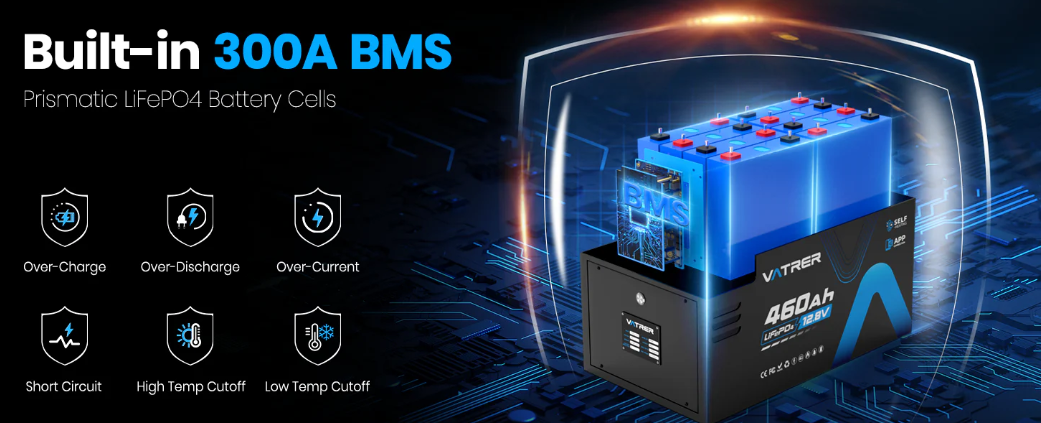
The Reality: A massive energy reservoir is useless if the "pipe" leading out of it is too narrow. True power delivery depends on the BMS (Battery Management System) rating, not just the Amp-hours.
Misconception #2: Lithium Performs Uniformly in Every Environment
Another misunderstanding is that lithium batteries behave identically regardless of temperature or installation conditions.
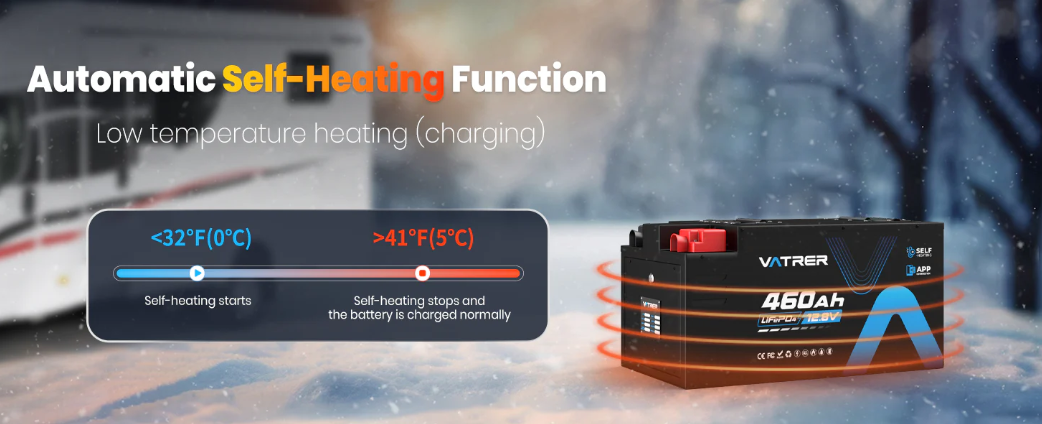
In reality, LiFePO4 chemistry is highly sensitive to the cold. If an RV system lacks smart thermal management, a premium 460Ah battery will experience strict charging restrictions in below-freezing temperatures to protect the cells from permanent plating damage. Without an integrated solution, a drop in ambient temperature can instantly paralyze your off-grid charging setup.
What Actually Improves Real-World Performance?
Instead of focusing solely on the size of the battery, the real breakthrough comes from system-level integration. Modern RV energy systems must solve multiple engineering challenges simultaneously: capacity, continuous high-current discharge, and environmental stability.
This is exactly where the engineering differences between a basic battery and an advanced power core like the Vatrer Power 12V 460Ah lithium battery become noticeable. A high-capacity battery shouldn't sit isolated in your electrical bay. It performs best when integrated into a smart infrastructure:
| The Real-World Problem | How the Vatrer 12V460Ah Battery Architecture Solves It |
|---|
| High-Load Appliance Spikes | Equipped with an industrial-grade 300A BMS, allowing up to 3,840W of continuous load power to run ACs and microwaves simultaneously without tripping safety shutoffs. |
| Freezing Temperatures | Features built-in self-heating technology that automatically warms the cells to a safe zone before accepting a charge from solar or alternators. |
| System Blind Spots | Integrates smart Bluetooth App monitoring, giving users real-time telemetry on cell voltage, temperature, and accurate State of Charge (SoC). |
"Best" Depends on Design, Not Just Specs
Searches for the "best 12V 460Ah lithium battery" often focus exclusively on numbers on a spec sheet— cycle life, cell grading, or price per watt-hour. But in practical, off-grid application, "best" is defined by how the system behaves under pressure:
• How stable is the voltage output when the water heater kicks on?
• How seamlessly does it transition from alternator charging (DC-to-DC) to solar?
• How much visibility does the user have into the system's actual health?
Most RV power complaints are not caused by insufficient capacity. They stem from poor load distribution, a lack of system visibility, and environmental vulnerabilities. Upgrading to a larger battery alone won't cure a poorly designed electrical system. However, when you anchor your rig with a system aware power core like the Vatrer battery—built to handle massive discharge currents, combat freezing climates, and communicate real-time data—the battery stops being a bottleneck and finally becomes the reliable foundation your off-grid adventures demand.
Ready to Build a Zero-Compromise RV Power System?
If you are tired of your inverter screaming every time you turn on the microwave, or worrying about your batteries freezing during a late-season mountain trip, it’s time to stop adding more batteries and start adding the right infrastructure. The Vatrer Power RV LiFePO4 Battery isn’t just a storage tank—it is a heavy-duty power core engineered to eliminate off-grid bottlenecks.
Learn more: Vatrer Power
